Minerva: Elevating Visual Communication Through Bold Outline Typography
The Strategic Role of Display Fonts in Modern Branding
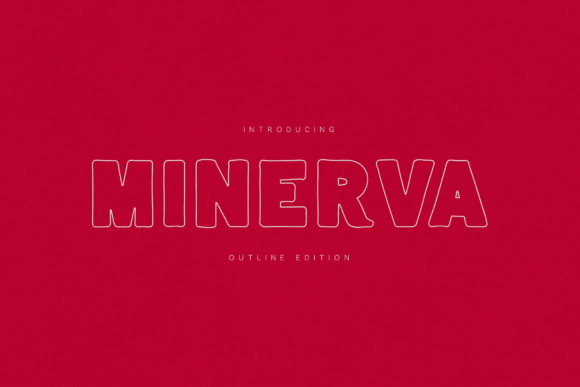
In the crowded landscape of visual communication, typography serves as the primary vehicle for tone and personality. While body text prioritizes legibility and neutrality, display fonts carry the heavy lifting of emotional resonance and brand recognition. Minerva occupies a distinct niche within this spectrum as a bold outline display font designed to inject character, energy, and a modern handcrafted feel into creative projects. Unlike standard solid typefaces that rely on mass and weight to command attention, Minerva utilizes negative space and structural lines to create a confident presence without visual heaviness.
This distinction is critical for designers and business owners navigating contemporary aesthetic trends. The shift away from sterile, hyper-minimalist corporate design has created a demand for typefaces that feel human, approachable, and intentionally imperfect. Minerva answers this need by balancing structured geometry with soft edges and rounded shapes. The result is a typographic voice that feels playful yet authoritative, making it an essential tool for brands seeking to differentiate themselves through warmth and accessibility rather than rigid formality.
Deconstructing the Outline Aesthetic
The Outline Edition of Minerva emphasizes form over fill, a design choice that fundamentally alters how the typeface interacts with its background. Solid bold fonts can sometimes dominate a layout, competing with photography or complex illustrations. In contrast, Minerva’s outline construction provides a light, airy, and graphic quality that maintains strong readability while allowing underlying textures or colors to breathe. This transparency makes it exceptionally versatile for layered compositions where depth and hierarchy are paramount.
Furthermore, the outline style introduces a retro-modern duality. It evokes the nostalgia of mid-century signage and vintage packaging while remaining firmly rooted in current digital design standards. The thick outlines ensure that the letterforms remain crisp and legible even at massive scales, preventing the thinning issues often associated with lighter outline fonts. For art directors and graphic designers, this means Minerva can be scaled up for billboards or down for merchandise labels without losing its defining characteristics or structural integrity.
Practical Applications Across Creative Mediums
Understanding where a typeface performs best is just as important as understanding its anatomy. Minerva’s specific attributes make it uniquely suited for several high-impact applications. Its bold proportions and expressive contours shine brightest when given room to dominate, but its versatility extends far beyond simple headlines.
- Posters and Event Signage: In poster design, the goal is instant communication. Minerva’s confident presence allows for short, punchy messaging that captures attention from a distance. The rounded shapes add a welcoming vibe to event materials, making them feel inclusive rather than exclusive.
- Packaging and Label Design: Consumer goods often struggle to balance shelf appeal with brand authenticity. Minerva’s handcrafted feel suggests artisanal quality and care, making it ideal for food and beverage labels, cosmetic packaging, and boutique retail products. The outline format works particularly well on colored substrates, creating a natural window effect that integrates the package color into the typography.
- Apparel and Merchandise: T-shirt graphics and streetwear rely heavily on typography that feels wearable and culturally relevant. Minerva bridges the gap between street style and polished design. Its imperfect contours prevent the text from looking like generic clip art, giving merchandise a custom, limited-edition appearance that resonates with consumers.
- Social Media Content Creation: Digital feeds move quickly, and static images must arrest the scroll. Minerva’s graphic quality translates perfectly to square and vertical formats. Because the font is inherently decorative, it reduces the need for additional embellishments or complex backgrounds, streamlining the content creation workflow for social media managers.
- Children’s Projects and Educational Materials: The soft edges and rounded forms of Minerva align naturally with demographics requiring approachable, non-threatening visuals. It is an excellent choice for book covers, classroom signage, and educational apps where friendliness and clarity must coexist.
Editorial and Web Implementation Considerations
While primarily a display face, Minerva finds a home in modern editorial design when used strategically. It functions effectively as a drop cap, a pull quote accent, or a section divider in magazines and digital publications. However, users should exercise restraint; because the font is so expressive, it works best when paired with highly legible sans-serif or serif body text. This contrast reinforces Minerva’s role as a highlighter of key information rather than a workhorse for long-form reading.
For web designers, the outline nature of Minerva offers performance and stylistic advantages. Outline fonts often render cleanly on high-DPI screens and can be manipulated with CSS to change stroke color or fill dynamically based on user interaction. This opens doors for interactive typography where hover states or scroll triggers can animate the font, adding a layer of engagement that solid typefaces cannot easily achieve.
Technical Versatility and Global Accessibility
A beautiful font is only useful if it functions reliably across different contexts and languages. Minerva includes a comprehensive character set that supports extensive multilingual requirements, ensuring that global brands can maintain visual consistency across diverse markets. This linguistic breadth is crucial for international campaigns where translating a headline shouldn't mean sacrificing the intended aesthetic.
Beyond alphabetic characters, the inclusion of numerals, punctuation, and specialized symbols allows for complete creative freedom. Designers can create pricing tables, dates, technical specifications, and social handles without breaking the visual rhythm. The numerals in Minerva share the same rounded, bold DNA as the letterforms, ensuring that data-heavy designs like infographics or sale announcements retain their playful, cohesive identity.
Pairing Strategies for Balanced Layouts
To maximize the effectiveness of Minerva, one must consider typographic pairing. Because Minerva is structurally complex and visually loud, it demands a supportive partner. Geometric sans-serifs provide a clean, neutral foundation that lets Minerva pop without competition. Conversely, pairing it with a traditional serif can create a sophisticated tension between old-world elegance and new-wave playfulness.
Designers should avoid pairing Minerva with other display fonts that have similar quirks or rounded terminals. Clashing personalities can lead to visual noise and confusion. Instead, treat Minerva as the protagonist of the layout. Let it occupy significant whitespace, and use secondary typefaces strictly for functional communication. This hierarchy ensures that the unique energy of Minerva remains the focal point rather than getting lost in a sea of competing styles.
The Psychology of Rounded and Imperfect Forms
The success of Minerva is not merely aesthetic; it is psychological. Research in typographic perception suggests that rounded typefaces are perceived as more friendly, safe, and approachable than their sharp-edged counterparts. The "imperfect contours" mentioned in Minerva's description trigger associations with human touch and craftsmanship. In an era dominated by AI-generated content and automated perfection, these subtle irregularities signal authenticity.
For businesses, this psychological cue is valuable. It softens commercial messaging, making advertisements feel less intrusive and more conversational. For educators and researchers, it lowers cognitive barriers, making complex or intimidating topics feel more accessible. The boldness of the outline provides the necessary confidence to ensure the message is taken seriously, while the roundness ensures it is received warmly. This dual capability makes Minerva a rare asset in strategic communication.
Future-Proofing Creative Assets
Trends in typography cycle rapidly, but fonts that prioritize fundamental principles of form and function tend to age gracefully. Minerva avoids fleeting gimmicks in favor of timeless structural qualities. The outline trend has seen resurgences for decades because it solves a perpetual design problem: how to be bold without being heavy. By anchoring itself in this enduring utility while applying a contemporary handcrafted finish, Minerva positions itself as a sustainable addition to a designer’s toolkit.
Investing in a typeface like Minerva is an investment in visual flexibility. Whether applied to a physical product label, a digital ad campaign, or an environmental sign system, the font adapts to the medium while retaining its core identity. For professionals and hobbyists alike, having such a versatile tool available reduces the time spent searching for the "right" font and increases the time spent refining the actual creative concept. Ultimately, Minerva demonstrates that typography is not just about arranging letters, but about shaping the emotional and functional experience of the audience.