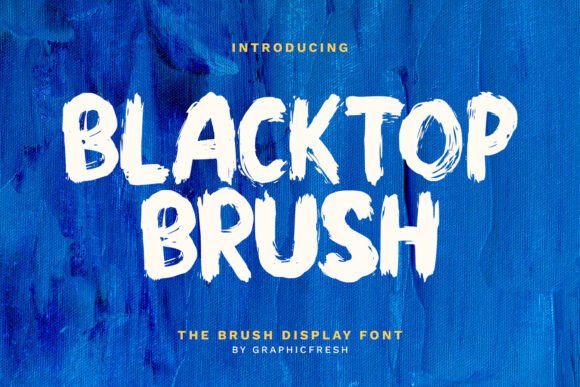
Blacktop: Bringing Urban Texture and Confidence to Modern Typography
In an era where digital content is consumed at a rapid pace, the first impression often hinges entirely on visual hierarchy. Designers and marketers are constantly seeking typefaces that can arrest attention without sacrificing legibility or brand integrity. Blacktop emerges as a definitive solution to this challenge, offering a bold display brush font crafted with strong strokes and confident character. Unlike traditional script fonts that prioritize elegance over impact, or industrial sans-serifs that can feel sterile, Blacktop occupies a vital middle ground. It is inspired by urban textures and expressive hand-painted lettering, delivering powerful visual impact with a modern edge that resonates with contemporary audiences.
The relevance of such a typeface extends beyond mere aesthetics. As brands navigate increasingly crowded social feeds and physical environments, the need for typography that feels authentic yet professional has never been greater. Blacktop combines raw texture with solid readability, creating a striking and versatile display style that serves both artistic expression and commercial utility. Its thick brush forms and dynamic flow make it perfect for headlines, branding, posters, social media graphics, and creative projects that demand attention, bridging the gap between street art sensibilities and corporate communication standards.
The Evolution of Authenticity in Digital Design
To understand why Blacktop fits so seamlessly into current design workflows, one must look at the broader shift in visual culture. For much of the early 2010s, the design world was dominated by flat design and ultra-clean geometric sans-serifs. While these styles improved usability and screen rendering, they eventually led to a sense of homogenization. Brands began to look identical, stripping away personality in favor of safe minimalism. We have since seen a pendulum swing back toward texture, imperfection, and human touch.
This resurgence is not about abandoning clarity; it is about enriching it. Users now expect digital experiences to feel tactile and grounded. Blacktop responds to this expectation by mimicking the physical resistance of a brush against pavement. The irregularities in its stroke weight and the organic edges of its letterforms signal human creation rather than algorithmic generation. In a landscape increasingly populated by AI-generated imagery and polished stock assets, this analog quality provides a necessary anchor. It suggests that there is a person behind the message, fostering trust and engagement through visual warmth.
Furthermore, the rise of short-form video content and mobile-first browsing has altered how typography functions. Text must be readable at smaller sizes and within fleeting timeframes. Delicate serifs and thin scripts often fail in these environments, disappearing against busy backgrounds or becoming illegible during quick scrolls. Blacktop’s substantial weight ensures it holds its own against vibrant photography and motion graphics, maintaining presence without requiring excessive scaling that disrupts layout balance.
Balancing Raw Expression with Functional Readability
A common pitfall in selecting display fonts is the trade-off between style and function. Many decorative typefaces are visually arresting in isolation but become problematic when applied to real-world messaging. They may lack essential glyphs, suffer from poor spacing, or possess idiosyncrasies that hinder quick comprehension. Blacktop distinguishes itself by prioritizing solid readability alongside its expressive nature.
The anatomy of the font reveals careful consideration of negative space. Despite its thick brush forms, the counters (the enclosed spaces within letters like 'o', 'a', and 'e') remain open enough to prevent ink bleed at larger sizes or pixelation at smaller resolutions. This technical refinement allows designers to use Blacktop confidently across various media, from large-format billboards to Instagram stories. The confidence in its character comes not just from its boldness, but from its reliability as a communication tool.
For professionals working under tight deadlines, this versatility reduces friction. There is no need to pair a decorative header with three different body fonts to compensate for legibility issues. Blacktop acts as a robust anchor point that supports cleaner, simpler companion typefaces. It does the heavy lifting in establishing tone, allowing the rest of the design system to remain understated and functional. This efficiency is crucial in modern agile workflows where speed and consistency are paramount.
Practical Applications Across Industries
The utility of Blacktop spans diverse sectors because its aesthetic is adaptable rather than prescriptive. It carries an urban energy that can be interpreted differently depending on context and color palette.
- Streetwear and Fashion: In apparel design, the font’s hand-painted lineage aligns naturally with skate, surf, and urban fashion cultures. It conveys movement and rebellion while remaining structured enough for merchandise tags and website headers.
- Food and Beverage Marketing: Craft breweries, coffee roasters, and artisanal food brands utilize textured typography to signal handmade quality. Blacktop evokes the chalkboard menus and stamped packaging associated with small-batch production, enhancing perceived value.
- Event Promotion and Entertainment: Music festivals, concerts, and nightlife venues require typography that vibrates with energy. The dynamic flow of Blacktop mirrors the rhythm of live performance, making it ideal for posters and ticket designs that need to stand out in dimly lit environments or crowded feeds.
- Social Media Content Creation: Influencers and content creators benefit from the font’s instant recognizability. When used consistently in thumbnails and story overlays, it builds a cohesive visual identity that helps audiences identify content before reading a single word.
- Corporate Rebranding: Even traditional businesses are adopting bolder typographic voices to appear more accessible and less bureaucratic. Used sparingly in campaign slogans or internal communications, Blacktop can inject vitality into established brands without alienating existing stakeholders.
Integrating Bold Typography into Modern Workflows
Adopting a font like Blacktop requires a shift in compositional thinking. Because the typeface possesses inherent texture and weight, it demands breathing room. Overcrowding Blacktop with other decorative elements or complex patterns dilutes its impact. Effective usage relies on contrast: pairing its rough edges with smooth surfaces, ample whitespace, and high-resolution imagery.
Color selection also plays a pivotal role in maximizing the font's potential. High-contrast combinations, such as white text on dark asphalt tones or neon accents against matte black, amplify its urban inspiration. However, softer palettes can yield surprising results, tempering the aggression of the brush strokes to create a nostalgic or approachable mood. Designers should experiment with opacity and blending modes to integrate the texture of the font with background elements, creating depth that feels intentional rather than superimposed.
From a technical standpoint, ensuring proper licensing and file format compatibility is essential for seamless integration. Modern variable font technology and comprehensive OpenType features allow for greater flexibility in adjusting weight and style to fit specific layouts. Professionals should verify that their chosen version of Blacktop includes necessary alternates and ligatures to avoid repetitive letterforms in longer headlines. Attention to kerning and tracking is equally important; while the font is designed with balanced spacing, manual adjustments may be required to achieve optical perfection in all-caps settings or unconventional arrangements.
Future-Proofing Visual Identity
Trends in typography are cyclical, but the underlying principles of effective communication remain constant. While specific stylistic flourishes may fade, the need for brands to project confidence and authenticity will persist. Blacktop succeeds because it addresses these fundamental needs rather than chasing a fleeting fad. Its foundation in hand-lettering traditions gives it a timeless quality, even as its execution feels thoroughly modern.
As augmented reality and spatial computing begin to influence graphic design, three-dimensional typography will gain prominence. Fonts with strong silhouettes and defined textures like Blacktop are uniquely positioned for this transition. Their bold forms translate well into volumetric space, and their textured surfaces provide realistic material properties for digital rendering. Investing in typefaces that bridge the physical and digital realms prepares creative assets for emerging platforms without necessitating complete redesigns.
Ultimately, the choice of typography is a strategic business decision. It shapes perception, guides user behavior, and encapsulates brand values in a fraction of a second. Blacktop offers a compelling proposition for those willing to embrace boldness. It validates the idea that professionalism does not require sterility and that impact does not require sacrificing clarity. By integrating this level of expressive confidence into their visual language, creators and businesses can forge stronger connections with audiences who crave genuine human expression in an increasingly automated world.
The enduring appeal of Blacktop lies in its ability to tell a story before the viewer reads the words. It speaks of city streets, creative passion, and unwavering resolve. In leveraging such a distinctive voice, designers do more than decorate a page; they imbue their work with a tangible sense of place and purpose. Whether applied to a global advertising campaign or a local community poster, the result is communication that feels alive, relevant, and unmistakably present.