Golden History: Evaluating a Playful Handcrafted Display Font
In the crowded marketplace of digital typography, finding a display font that balances genuine character with professional usability is a distinct challenge. Golden History enters this space as a handcrafted typeface designed specifically to impart a sense of joy and approachability to visual projects. Unlike rigid geometric sans-serifs or overly formal serifs, this font operates in the niche of amicable personality. It is engineered not for body copy or data-heavy interfaces, but for moments where design needs to communicate warmth, celebration, and human connection. For designers, marketers, and small business owners, understanding the specific utility of Golden History requires looking beyond its aesthetic charm to evaluate its functional performance in real-world applications.
Defining the Aesthetic and Functional Profile
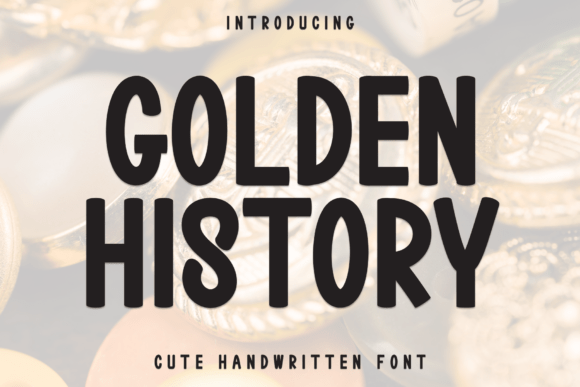
Golden History is best categorized as a playful, handwritten display font. Its construction mimics the organic irregularities of natural penmanship while maintaining the consistency required for digital reproduction. The letterforms exhibit a bouncy baseline and varied stroke widths, creating a rhythm that feels spontaneous rather than manufactured. This "handmade" quality is its primary value proposition. In an era where AI-generated imagery and sterile corporate branding dominate, assets that signal human effort and authenticity carry significant weight.
The font’s personality is distinctly jovial without veering into childishness. This distinction is critical for professional use. Many novelty fonts sacrifice legibility for whimsy, rendering them useless for anything beyond a single decorative word. Golden History maintains sufficient x-height and open counters to ensure readability at moderate display sizes. The characters interact with a sense of flow, making it suitable for multi-word headlines, invitation suites, and packaging labels where the text must be parsed quickly by the viewer. The aesthetic wraps words in a warm ambiance, effectively softening the tone of any accompanying visual elements.
Practical Applications and Use Cases
The versatility of a display font is measured by how well it adapts to different contexts while retaining its core identity. Based on its structural characteristics, Golden History performs optimally in several specific scenarios:
- Wedding and Event Stationery: This is perhaps the most natural habitat for this typeface. It bridges the gap between traditional calligraphy and modern casual elegance. It works exceptionally well for save-the-dates, welcome signs, and menu headers where the goal is to make guests feel relaxed and welcomed rather than intimidated by formality.
- Greeting Cards and Personal Correspondence: For publishers and creators in the stationery space, the font offers a scalable alternative to custom lettering. Its amicable nature suits birthdays, thank-you notes, and holiday cards, providing a consistent brand voice across diverse product lines.
- Boutique Branding and Packaging: Small businesses in artisanal sectors—such as bakeries, florists, craft breweries, and children’s apparel—benefit from this font’s handcrafted ethos. It signals "small batch" and "carefully made" more effectively than standard commercial typefaces.
- Social Media Graphics and Content Creation: Influencers and social media managers can utilize Golden History for quote overlays, story highlights, and thumbnail text. The high contrast and distinctive shapes remain legible on mobile screens, stopping the scroll through visual texture.
Evaluating Usability and Technical Performance
A charming font is only as good as its technical execution. When integrating Golden History into a professional workflow, several factors determine its long-term value. The spacing and kerning are generally well-balanced for a handwritten style, though manual adjustment may be necessary for specific letter combinations depending on the software used. Because the baseline is intentionally uneven to simulate handwriting, designers should avoid using this font in all-caps settings or tight tracking. Doing so disrupts the natural cadence of the letterforms and reduces legibility. Instead, allow the font to breathe with generous leading and standard or slightly loose tracking.
Weight variation is another consideration. As a single-style display font, Golden History lacks the family range of a workhorse text face. This limitation is actually a strength in disguise; it forces intentional hierarchy. Designers must pair it with a neutral sans-serif or a clean serif to handle subheads and body copy. This constraint often leads to cleaner, more focused layouts where the display font serves as a true accent rather than competing for attention. The reliability of the vector outlines ensures that the font renders crisply across print and digital mediums, avoiding the jagged edges sometimes found in lower-quality novelty typefaces.
Audience Fit and Strategic Value
Not every project requires a touch of delight, and recognizing when not to use Golden History is as important as knowing when to use it. Professionals evaluating this asset should consider their target demographic and brand positioning.
Ideal Beneficiaries:
- Lifestyle and Wellness Brands: Businesses focused on self-care, parenting, or community building will find the font’s warmth aligns perfectly with their messaging.
- Freelance Creatives: Photographers, illustrators, and writers who want their personal branding to feel accessible and friendly rather than corporate.
- Educators and Non-Profits: Organizations that need to communicate approachability and reduce anxiety in their audience, such as early childhood education centers or community support groups.
Less Suitable Contexts:
Conversely, industries requiring authority, precision, or solemnity may find this typeface counterproductive. Legal firms, financial institutions, medical technology companies, and luxury fashion houses typically require typography that conveys stability and exclusivity. In these sectors, the playfulness of Golden History could be misread as unprofessional or lacking seriousness. Similarly, user interface design and extensive editorial layouts are poor fits; the font is strictly for display purposes and will fatigue readers if used for paragraphs.
Maximizing Impact Through Pairing and Layout
To extract the full value from Golden History, strategic pairing is essential. The font carries significant visual weight due to its texture and personality. Pairing it with another decorative font often results in visual clutter. The most effective combinations involve high-contrast neutrality. A geometric sans-serif like Montserrat or Futura provides a stable foundation that lets the handwritten elements shine. Alternatively, a classic transitional serif like Merriweather adds a touch of tradition that grounds the playfulness, making it appropriate for more mature audiences.
Color choice also influences perception. While black or dark grey offers maximum versatility, utilizing muted earth tones, pastels, or metallic foils in print can enhance the "golden" and historic undertones suggested by the name. In digital environments, ensuring sufficient contrast ratios against the background is mandatory for accessibility. Because the strokes vary in thickness, thin sections of the letters may disappear on low-contrast backgrounds. Always test the font at the smallest intended size before finalizing production files.
Long-Term Value and Licensing Considerations
For freelancers and agencies, the return on investment for a display font depends on licensing flexibility and trend resistance. Handwritten fonts can sometimes feel dated quickly if they mimic a specific passing fad. Golden History avoids this pitfall by drawing on timeless script structures rather than trendy distortions. Its classic yet cheerful aesthetic suggests it will remain relevant for years, making it a safer investment than ultra-stylized novelty faces.
Users should verify the specific license terms regarding commercial use, web embedding, and merchandise. If you plan to use the font for client work, logo creation, or products for resale, ensuring the appropriate commercial license is secured protects both the designer and the end client. From a workflow perspective, having a reliable, go-to option for "friendly display" tasks reduces time spent searching through font libraries. Efficiency in asset selection directly correlates to project profitability.
Final Assessment for Creative Professionals
Golden History succeeds because it delivers on a specific promise: transforming ordinary text into an enchanting, amicable experience without sacrificing professional standards. It is a specialized tool, not a universal solution. Its strengths lie in emotional communication, visual storytelling, and adding a human touch to digital and print media. For wedding planners, greeting card designers, boutique marketers, and content creators, it offers a dependable way to inject joy into visual hierarchies.
However, its effectiveness relies entirely on restraint and context. It is a seasoning, not the main course. When used sparingly and paired correctly, it elevates designs from functional to memorable. When overused or misplaced, it risks undermining credibility. Professionals should view Golden History as a valuable addition to their typographic toolkit for specific emotional objectives. By understanding its boundaries and leveraging its inherent warmth, designers can create radiant visual stories that leave a genuinely endearing impression on their audience. Ultimately, it is a testament to the enduring power of handwritten aesthetics in a digital-first world, proving that functionality and delight are not mutually exclusive.