Onlink: Evaluating a Playful Display Font for Creative Projects
Selecting the right typeface is one of the most critical decisions in visual communication. Typography does not merely convey text; it establishes tone, influences readability, and shapes the viewer's emotional response before they process a single word. For designers seeking to inject warmth and energy into their work, Onlink presents itself as a playful display font designed to balance bold personality with functional clarity. Understanding where this typeface fits within a broader design system requires an objective look at its characteristics, technical specifications, and practical applications.
Defining the Visual Character of Onlink
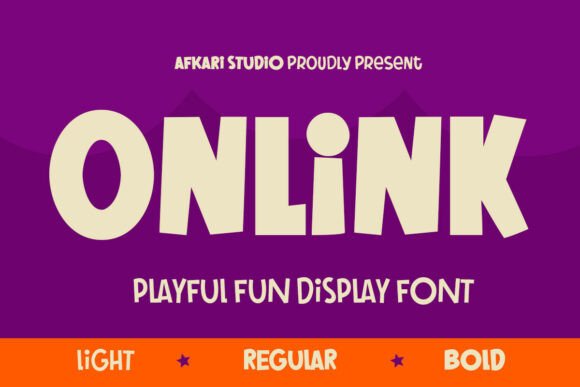
Onlink is categorized as a display font, meaning it is engineered primarily for large-scale usage such as headlines, logos, and short-form messaging rather than extended body copy. Its defining characteristic is a modern, playful aesthetic that avoids appearing juvenile or unprofessional. The letterforms are constructed with friendly character shapes and lively curves that create an approachable visual texture. Unlike rigid geometric sans-serifs or traditional serifs, Onlink utilizes organic modulation to suggest movement and cheerfulness.
The typeface includes uppercase and lowercase characters, numbers, and essential punctuation, providing a complete basic character set for standard Latin-based layouts. A significant functional aspect of Onlink is its multilingual support, including specific glyphs for characters such as ä, ö, ü, Ä, Ö, Ü, ß, ¿, and ¡. This extended character set makes it a viable option for projects targeting diverse linguistic demographics without requiring supplementary font files or manual glyph adjustments.
Technical Specifications and Workflow Integration
From a production standpoint, versatility in file formats reduces friction during the design handoff and development phases. Onlink is available in OTF, OTT, WOFF, and WOFF2 formats. The inclusion of OpenType formats (OTF/OTT) ensures compatibility with professional desktop publishing software like Adobe InDesign and Illustrator, while WOFF and WOFF2 formats are optimized specifically for web performance. WOFF2, in particular, offers superior compression, ensuring that the playful aesthetics do not come at the cost of page load speed.
The family structure includes three distinct weights: Light, Regular, and Bold. This triad allows designers to establish visual hierarchy within the display context. For example, the Bold weight can serve as a primary attention-grabber for main titles, while the Regular or Light weights can be utilized for subheads or secondary callouts. Having multiple weights within a single playful family prevents the need to mix disparate typefaces, which can often lead to visual dissonance.
Accessibility is another practical consideration. Onlink is described as fully accessible without additional design software. This suggests that special ligatures or alternate characters are either mapped to standard Unicode points or are easily accessible through standard OpenType features, streamlining the workflow for designers who may not have advanced typographic training.
Strategic Applications and Ideal Use Cases
Evaluating whether Onlink aligns with project goals involves matching its inherent traits to the desired user experience. This typeface is particularly strong in contexts where the objective is to lower psychological barriers and foster engagement.
- Children’s Education and Media: The friendly, rounded forms align naturally with educational materials, book covers, and apps designed for younger audiences. The readability at larger sizes ensures that early readers can recognize letter shapes easily.
- Lifestyle and Wellness Branding: Brands focusing on joy, self-care, or community often require typography that feels human rather than corporate. Onlink provides a warm alternative to sterile minimalism.
- Event Marketing and Packaging: For festivals, food products, or casual retail, the energetic nature of the font helps packaging stand out on shelves and creates excitement in promotional materials.
- Digital Headlines and Social Media: In digital environments where attention spans are short, the bold personality of Onlink serves as an effective hook. The WOFF2 support ensures this visual impact translates efficiently to mobile screens.
Considerations and Tradeoffs
While Onlink offers distinct advantages for specific niches, it is not a universal solution. Designers must weigh certain tradeoffs when integrating a playful display font into a comprehensive system.
Readability Limits: Although Onlink maintains strong readability for headlines, its decorative nature makes it unsuitable for body text. Extended reading requires neutral typefaces with consistent rhythm and spacing. Using Onlink for paragraphs will likely cause eye fatigue and reduce comprehension. It should always be paired with a highly legible sans-serif or serif for supporting content.
Tone Alignment: The cheerful energy of Onlink is a double-edged sword. It is ill-suited for industries requiring gravitas, authority, or solemnity, such as legal services, luxury finance, or medical crisis communications. In these contexts, the playfulness could be misinterpreted as a lack of seriousness or professionalism.
Hierarchy Management: Because display fonts are inherently loud, using too many weights simultaneously can create visual clutter. While the Light, Regular, and Bold options provide flexibility, best practices suggest limiting usage to one or two weights per layout to maintain focus. Overusing the Bold weight, in particular, can diminish its impact and make the design feel heavy.
Making the Selection Decision
When comparing Onlink against other playful display fonts, consider the specific balance between novelty and utility. Some novelty fonts sacrifice legibility for style, rendering them unusable at smaller headline sizes. Onlink’s emphasis on modern construction and readability positions it as a more functional choice for commercial work where clarity cannot be compromised.
Additionally, evaluate the technical requirements of your project. If you are working across both print and web, the comprehensive format package (OTF plus WOFF2) adds significant value compared to fonts that only offer desktop licenses. Similarly, if your project involves German, Spanish, or other languages requiring special diacritics, verifying multilingual support upfront prevents costly redesigns later in the production cycle.
Ultimately, Onlink serves as a specialized tool for creatives aiming to humanize their designs. It is most effective when treated as an accent rather than a foundation. By understanding its strengths in conveying joyful, bold personality and respecting its limitations regarding body text and formal contexts, designers can leverage Onlink to create work that is both expressive and strategically sound. The decision to use it should stem from a clear alignment between the font’s energetic character and the project’s communication objectives.