Happy Groov: Layered Retro Font for Vibrant Design
Nostalgia is a powerful tool in visual communication, but leveraging it effectively requires more than just applying a sepia filter or using generic vintage scripts. True retro design captures the emotional resonance of an era while maintaining modern legibility and technical precision. Happy Groov – Layered Retro Font achieves this balance by channeling the bold, cheerful spirit of the 1960s and 70s into a functional typeface built for contemporary projects. Unlike distressed grunge fonts that mimic age through degradation, this typeface celebrates the optimism of mid-century graphic design with clean geometry and intentional layering.
For designers, marketers, and business owners, selecting a display font is often a high-stakes decision. The typeface must carry the brand’s personality without sacrificing readability at various sizes. Happy Groov distinguishes itself through its chunky, bubble-like letterforms and exaggerated counters. These aren't accidental stylistic choices; they are engineered to create positive space that allows color and texture to breathe within the character itself. This structural approach makes the font exceptionally versatile for everything from artisanal packaging to digital social media campaigns.
Anatomy of Optimism: Understanding the Letterforms
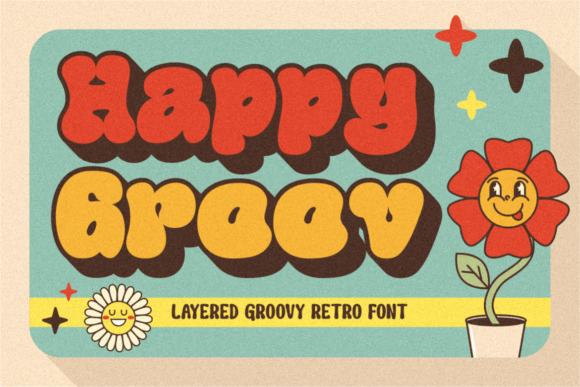
The immediate appeal of Happy Groov lies in its heavy outline and layered structure, but its utility comes from how these elements interact. The smooth curves avoid the sharp edges typical of some psychedelic typefaces, making it feel approachable rather than aggressive. The "bubble" aesthetic is constructed with precise bezier curves that maintain consistency across the entire alphabet. This uniformity is crucial when setting longer headlines or logos where irregular spacing can disrupt the visual rhythm.
The layered aspect serves a dual purpose. Aesthetically, it adds dimension and a cartoonish energy that feels hand-drawn yet polished. Practically, it provides built-in styling options without requiring complex vector manipulation. Designers can utilize the layers to introduce secondary colors, shadows, or textures directly through OpenType features or standard layering techniques in software like Illustrator or Canva. This reduces production time significantly compared to manually outlining and offsetting standard bold fonts to achieve a similar retro effect.
Strategic Applications Across Industries
Versatility is the hallmark of a successful display typeface. While Happy Groov is undeniably funky, its application extends far beyond novelty uses. Its warmth and playfulness make it a strategic asset in several professional contexts:
- Artisanal and CPG Packaging: The food and beverage industry frequently utilizes retro typography to signal authenticity and heritage. Happy Groov works exceptionally well for craft beer labels, hot sauce bottles, and organic snack packaging. The chunky weight ensures legibility on crowded shelves, while the playful tone suggests natural ingredients and small-batch quality.
- Event Branding and Signage: Music festivals, farmers markets, and community fairs require typography that feels welcoming and energetic. This font thrives in large-format printing, maintaining its integrity on banners, wayfinding signs, and stage backdrops. The exaggerated counters remain open even when viewed from a distance, preventing the letters from filling in with ink or pixelating.
- Children’s Education and Publishing: Educators and publishers know that friendly typography aids engagement. The rounded, non-threatening forms of Happy Groov are ideal for book covers, classroom posters, and educational apps. It supports literacy development by presenting distinct, recognizable letter shapes that differ significantly from standard sans-serifs, helping young readers differentiate characters.
- Sustainable and Eco-Conscious Campaigns: There is a strong historical link between 70s aesthetics and environmental movements. Brands focusing on sustainability, recycling, or outdoor conservation can use this font to tap into that cultural memory. It communicates earthiness and positivity, avoiding the sterile, clinical look that sometimes plagues eco-branding.
- Apparel and Merchandise: T-shirt designers and print-on-demand entrepreneurs benefit from the font’s inherent graphic quality. Because the letterforms are so distinct, they often function as illustrations themselves, reducing the need for additional clip art. The layered structure also translates beautifully to screen printing and embroidery digitizing.
Technical Considerations for Professional Implementation
A beautiful font is useless if it creates friction in the workflow. When evaluating Happy Groov for commercial or personal use, consider the technical specifications that impact real-world output. The inclusion of multilingual support and comprehensive punctuation coverage is a significant advantage over many free or hobbyist retro fonts. This ensures that global brands can maintain consistent voice across different language markets without resorting to mismatched fallback fonts for accented characters.
When implementing this typeface, hierarchy is key. Due to its heavy weight and decorative nature, Happy Groov should primarily serve as a headline or logo element. Pairing it with a clean, neutral sans-serif or a simple monospaced font for body copy creates necessary contrast. Attempting to use it for paragraphs will result in visual fatigue and poor readability. Think of it as the lead singer in a band; it needs the rhythm section of simpler typography to truly shine.
Color selection also plays a pivotal role in maximizing the font's potential. The layered structure invites experimentation with complementary and analogous color schemes. High-contrast combinations (like orange and teal) amplify the retro vibe, while tonal variations (like forest green and sage) soften the impact for more subdued, sophisticated applications. Always test your color choices in both RGB and CMYK spaces if the project spans digital and print media, as vibrant retro palettes can shift during conversion.
Enhancing Brand Personality Through Typography
Typography is rarely just about reading; it is about feeling. In an era dominated by minimalist corporate sans-serifs, choosing a typeface like Happy Groov is a deliberate act of differentiation. It signals to the audience that the brand values joy, creativity, and human connection. For freelancers and agencies, offering this level of typographic personality can elevate client work beyond generic templates.
The psychological impact of rounded, bubbly letterforms cannot be overstated. Research in typographic perception consistently shows that curved shapes are associated with safety, comfort, and positivity. By integrating Happy Groov into a design system, you are subtly priming the viewer for a positive experience. This is particularly valuable for brands trying to soften their image or connect with audiences on an emotional level. Whether used for a serious topic presented with hope or a purely celebratory announcement, the font carries an intrinsic warmth that rigid geometric typefaces simply cannot replicate.
Ultimately, the value of Happy Groov lies in its ability to make the past feel present. It avoids the trap of being a costume piece and instead functions as a robust design tool. For creators looking to inject vitality into their work, this layered retro font offers a reliable, joyful solution that respects both design history and modern usability standards. It transforms standard text into a visual experience, ensuring that every headline, logo, or label feels like a genuine invitation to engage.