Wobblix: Bringing Handmade Warmth to Modern Digital Design
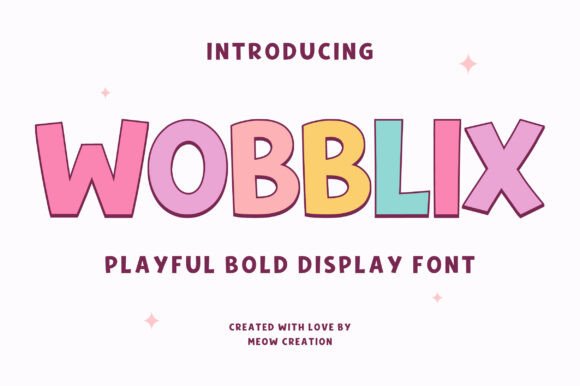
In an era dominated by sleek minimalism and rigid geometric grids, the creative landscape is experiencing a significant shift toward organic imperfection. Designers and brands are increasingly seeking typefaces that feel human, approachable, and distinct from the sterile aesthetics of standard system fonts. Wobblix has emerged as a definitive answer to this craving for authenticity. It is a bold and cheerful display font with soft curves and slightly wobbly letterforms that give it a fun, handmade feel. Unlike traditional hand-lettered styles that often sacrifice legibility for artistic flair, its chunky structure makes every word stand out while staying clear and highly readable.
This balance between playful aesthetics and functional clarity is what separates fleeting design fads from enduring typographic tools. For professionals ranging from freelance illustrators to marketing directors at lifestyle brands, Wobblix offers a versatile solution for injecting personality into visual communications. It serves as a bridge between the nostalgia of analog craftsmanship and the demands of high-resolution digital screens, proving that friendly typography can still command authority and attention in competitive markets.
The Resurgence of Organic Typography in Digital Spaces
To understand the relevance of Wobblix, one must first recognize the broader evolution of consumer preferences over the last decade. The early 2010s were defined by flat design and corporate Memphis styles, which prioritized efficiency and scalability above all else. While effective for user interfaces, these trends eventually led to a sense of visual homogenization. Audiences began to associate perfectly straight lines and uniform spacing with impersonal corporate entities. In response, a "new sincerity" movement has taken root in graphic design, valuing texture, irregularity, and emotional resonance.
Wobblix fits precisely into this cultural moment. Its slightly uneven baseline and rounded terminals mimic the natural variations found in marker drawings or clay modeling. This is not merely an aesthetic choice; it is a psychological signal. Research in design perception suggests that rounded, irregular shapes are processed by the brain as safer and more welcoming than sharp, angular forms. When a user encounters Wobblix on a social media feed or a product package, the immediate subconscious association is one of creativity and accessibility rather than bureaucracy. This makes the font particularly valuable for brands attempting to soften their image or connect with younger demographics who prioritize authenticity over polish.
Balancing Whimsy with Commercial Legibility
A common pitfall when adopting "fun" fonts is the loss of readability. Many novelty typefaces look excellent in a logo but fail catastrophically when used for headlines, captions, or merchandise. Wobblix avoids this trap through intentional structural engineering. Despite its wobbly character, the font maintains consistent stroke weights and generous counter spaces (the enclosed areas within letters like 'o', 'a', and 'e'). These technical decisions ensure that the typeface remains legible even at smaller sizes or when viewed quickly on mobile devices.
For creators, this means Wobblix can be deployed with confidence across various touchpoints without requiring extensive manual kerning or adjustment. It retains its charm whether it is scaled up for a billboard or condensed for an Instagram story overlay. This reliability transforms it from a niche decorative element into a workhorse display font capable of carrying entire branding campaigns. The chunky proportions also provide ample surface area for color treatments, textures, and effects, allowing designers to customize the mood without compromising the fundamental integrity of the letterforms.
Practical Applications Across Creative Industries
The versatility of Wobblix extends far beyond generic "playful" projects. Its specific characteristics make it uniquely suited for several high-demand commercial applications where tone and readability must coexist.
- Apparel and Merchandise: T-shirts and tote bags require typography that reads instantly from a distance. The bold weight of Wobblix ensures visibility, while the handmade aesthetic aligns perfectly with the personal nature of wearable art. It avoids the stiff appearance of standard block letters, making merchandise feel like limited-edition art rather than mass-produced promotional gear.
- Kids’ Products and Education: Designing for children requires avoiding condescension. Wobblix strikes a mature yet youthful tone that appeals to both kids and the parents purchasing the products. Its softness feels safe and engaging for educational materials, book covers, and toy packaging without looking infantile.
- Social Media Content Creation: In the fast-scrolling environment of TikTok, Instagram, and Pinterest, text must act as a visual hook. Wobblix adds a bright, modern, and friendly personality to any creative project, helping static graphics and video thumbnails arrest attention more effectively than neutral sans-serifs.
- Artisanal and Food Branding: Cafes, bakeries, and craft businesses benefit from typography that implies human involvement. Using Wobblix on menus, signage, or packaging subtly reinforces the message that products are made with care, supporting premium pricing and brand loyalty.
Integrating Personality into Professional Workflows
Modern design workflows are faster and more collaborative than ever before. Teams often rely on shared asset libraries and design systems to maintain consistency. Historically, expressive fonts were difficult to integrate into these systems because they required specialized handling. Wobblix supports contemporary workflows by being technically robust. It pairs exceptionally well with clean, neutral body copy such as Inter, Roboto, or Open Sans. This contrast creates a clear visual hierarchy: Wobblix handles the emotional heavy lifting in headlines and call-to-actions, while the supporting typeface manages information density.
For freelancers and agency designers, this pairing strategy allows for rapid iteration. You can swap out body copy or adjust layout grids without losing the distinctive voice established by the display font. Furthermore, because Wobblix is designed with digital rendering in mind, it performs consistently across different operating systems and browsers. This reduces the friction often associated with custom typography, where designers spend hours troubleshooting rendering issues or creating fallback images. By choosing a font that is both stylistically distinct and technically sound, professionals can deliver higher-quality work in less time.
Navigating Trends Without Losing Timelessness
While Wobblix capitalizes on current trends toward softness and humanity, it is important to distinguish between trend-chasing and strategic design choices. Trends fade, but principles of good communication endure. The reason Wobblix avoids feeling dated is that it references timeless qualities of handcraft rather than specific internet micro-trends. It does not rely on glitch effects, extreme distortion, or meme-referential shapes that will inevitably age poorly. Instead, it draws from the enduring appeal of sign painting, children’s literature, and mid-century advertising.
This grounding in historical precedent gives the font longevity. Businesses investing in Wobblix for rebranding efforts can trust that it will not look obsolete in two years. It occupies a sweet spot where it feels fresh enough to capture current attention but classic enough to build long-term equity. For content creators and educators, this means building a visual identity that audiences can grow accustomed to and trust over time, rather than constantly reinventing their aesthetic to stay relevant.
Strategic Recommendations for Implementation
To maximize the impact of Wobblix, users should approach it with intentionality rather than treating it as a default setting. Here are practical considerations for getting the best results:
- Mind the Spacing: While the font includes built-in metrics, display typography often benefits from slight tightening at large sizes to create a cohesive word shape. Conversely, avoid excessive tracking (letter-spacing) which can break the connected, handwritten illusion.
- Color Psychology: Wobblix responds beautifully to vibrant, saturated palettes that enhance its cheerful nature. However, it also works surprisingly well in monochrome or muted earth tones for a more sophisticated, retro-modern look. Test color combinations against your specific audience demographics.
- Contextual Appropriateness: Reserve Wobblix for moments where you want to evoke emotion, welcome the viewer, or highlight key information. Avoid using it for dense paragraphs, legal disclaimers, or data-heavy tables where its personality would become distracting and hinder comprehension.
- Pair with Purpose: Let Wobblix be the star. If you use it for headlines, ensure your secondary fonts are understated. Competing display fonts will create visual noise and dilute the friendly impact you are trying to achieve.
Ultimately, typography is a tool for communication, not just decoration. Wobblix succeeds because it solves a genuine problem in modern design: the need to convey warmth and individuality in a medium that often feels cold and automated. Whether you are designing a poster for a community event, launching a new line of sustainable goods, or simply wanting to make your social media quotes more engaging, this typeface provides the necessary character to make your message resonate. By embracing the beauty of slight imperfection, creators can forge deeper connections with their audiences, proving that in a digital world, the most impactful designs are often those that feel the most human.