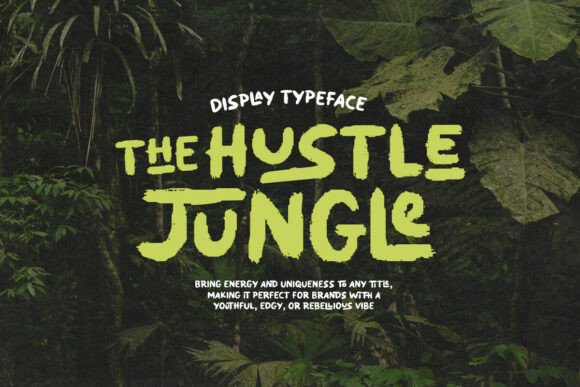
Hustle Jungle: Evaluating a Raw Display Typeface for High-Impact Design
In the crowded landscape of digital typography, finding a display font that balances aesthetic aggression with functional legibility is a persistent challenge for designers. The Hustle Jungle typeface enters this space as a specialized tool for projects requiring raw, untamed energy. Unlike versatile sans-serifs or traditional serifs designed for broad utility, Hustle Jungle is a niche asset built specifically for rebellion and youthful vigor. Its defining characteristic is a series of jagged, brush-like edges that simulate the appearance of text carved directly into organic surfaces. For professionals evaluating their typographic toolkit, understanding the specific utility and limitations of this font is essential before integrating it into commercial workflows.
Defining Characteristics and Visual Mechanics
The primary value proposition of The Hustle Jungle font lies in its texture. It rejects the clean vectors typical of modern digital design in favor of a distressed, hand-hewn aesthetic. The letterforms are not merely shaped; they appear eroded. This creates an immediate sense of history and physical interaction, even when applied to purely digital mediums. The edges are irregular, mimicking the resistance of wood grain or stone against a carving tool. This organic imperfection serves a psychological purpose: it signals authenticity in an era of polished, AI-generated perfection.
From a technical standpoint, the typeface operates as a high-contrast display solution. The weight distribution is heavy, ensuring that the intricate edge details remain visible even at smaller headline sizes. However, the internal counters (the negative space within letters) are often tight due to the rough exterior treatment. This mechanical reality dictates its usage parameters. It is not a typeface for nuance or subtlety; it is a visual shout. When evaluating this font for a project, one must recognize that its strength is also its constraint. It dominates the visual hierarchy, demanding that all supporting elements defer to its intensity.
Practical Applications in Commercial Design
While aesthetically distinct, The Hustle Jungle typeface must be judged on its performance in real-world scenarios. Based on current design trends and audience reception, three primary sectors benefit most from this asset:
- Streetwear and Apparel Branding: Fashion labels targeting Gen Z and Millennial demographics often rely on "anti-design" aesthetics to signal counter-culture alignment. Hustle Jungle provides the necessary grit for garment tags, oversized back prints, and lookbook headers without appearing artificially aged.
- Extreme Sports and Adventure Media: Whether for motocross event posters, surf competition branding, or adventure vlog thumbnails, this font communicates kinetic energy. The jagged edges imply motion and danger, aligning perfectly with the subject matter’s inherent risk.
- Music and Event Promotion: For genres like punk, metal, industrial techno, or underground hip-hop, standard typography can feel too corporate. This typeface offers a bespoke, DIY quality that resonates with subcultures valuing independence and raw expression.
Beyond these core verticals, the font has found utility in YouTube thumbnail design. In a platform where click-through rates depend on instant visual recognition, the high-frequency detail of Hustle Jungle stands out against the smooth gradients and flat colors common in video metadata. It acts as a pattern interrupt, drawing the eye through sheer textural contrast.
Integration Strategies and Pairing Recommendations
A common failure point when using highly stylized display fonts is poor contextualization. The Hustle Jungle font does not exist in a vacuum; its effectiveness is entirely dependent on its environment. To maximize its impact while maintaining professional standards, designers should consider the following integration strategies.
Texture Amplification: Because the font already possesses significant edge detail, placing it on a flat white background can sometimes make it look like a clip-art artifact. Instead, integrate it with gritty textures such as concrete overlays, film grain, or halftone patterns. This grounds the typeface, making the distress effects feel environmental rather than applied. For outdoor or adventure brands, pairing the text with moody jungle photography or desaturated nature shots reinforces the thematic link between the name and the visual output.
Color Theory Application: The font’s density makes it an excellent candidate for neon accents against dark backgrounds. The rough edges interact uniquely with glow effects, creating a diffused light source that feels more natural than it would with a crisp geometric sans-serif. Conversely, high-contrast black-and-white applications emphasize the silhouette of the letterforms, stripping away distraction and focusing purely on shape and attitude.
Typographic Hierarchy: Never use The Hustle Jungle for body copy. Its readability degrades rapidly below 24pt (or equivalent web sizing). Pair it with a neutral, highly legible grotesque or monospaced typeface for secondary information. The contrast between the chaotic energy of the headline and the structured stability of the supporting text creates a dynamic tension that guides the viewer’s eye effectively. This balance is crucial for maintaining usability in web design and print layouts where information retention matters as much as aesthetic impact.
Evaluating Usability and Technical Limitations
Professionals must approach The Hustle Jungle with a clear understanding of its operational boundaries. While it excels at capturing attention, it presents specific challenges that require mitigation.
- Legibility Constraints: The distressed edges reduce character recognition speed. Avoid using it for critical navigational elements, legal disclaimers, or complex data visualization. If a user needs to read the text instantly to perform a task, this is likely the wrong choice.
- Scalability Issues: While designed for large formats, extreme enlargement can sometimes reveal vector artifacts if the source file resolution is insufficient. Always verify the font’s outline quality before committing to billboard or large-format banner printing.
- Tonal Specificity: This is not a flexible workhorse. Using Hustle Jungle for a corporate annual report, a luxury spa, or a pediatric clinic would create severe cognitive dissonance. Its voice is singular and loud; misapplying it can damage brand credibility by signaling a lack of audience awareness.
- Licensing Compliance: As with any specialized display font, verify the licensing terms for commercial use, particularly for merchandise and broadcast media. Independent foundries often have tiered pricing structures based on impression counts or unit sales.
Long-Term Value and Workflow Integration
When assessing whether to add The Hustle Jungle typeface to a permanent resource library, consider its longevity versus trend dependency. Distressed and grunge typography cycles in and out of mainstream popularity. However, the specific "hand-carved" execution of this font places it closer to artisanal craft than fleeting internet aesthetics. This suggests a longer shelf life for brands rooted in authenticity, outdoor culture, or independent art scenes.
For freelancers and agency designers, owning this asset reduces the time spent manually distressing clean fonts—a process that often yields unconvincing results. Having a purpose-built tool ensures consistency across campaigns and allows for rapid iteration during concept phases. The font’s distinct personality also serves as a creative prompt; its unique forms can inspire layout decisions, color palettes, and image treatments that might not emerge from a blank canvas.
Ultimately, The Hustle Jungle is a specialist instrument. It solves a specific problem: how to communicate intensity, rebellion, and organic energy without resorting to cliché. For the right project, it transforms standard typography into a visceral experience. For the wrong project, it is merely noise. Professional judgment lies in distinguishing between the two. By respecting its limitations and leveraging its strengths through thoughtful pairing and contextual application, designers can harness its raw power to create work that is not only seen but felt. In a digital ecosystem saturated with sameness, such distinctiveness is a measurable competitive advantage.