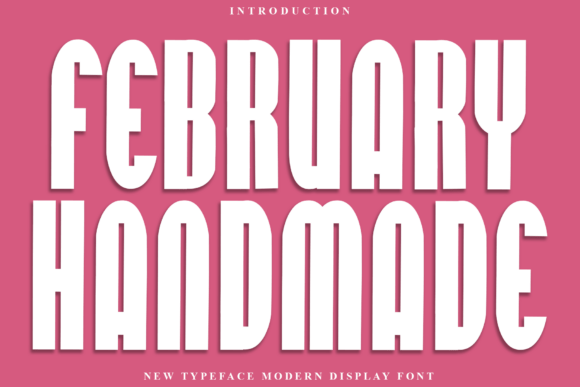
Evaluating February Handmade for Holiday Design Projects
Selecting the appropriate typeface is a critical step in establishing the visual tone of any seasonal project. For designers and hobbyists focusing on winter holidays, February Handmade presents itself as a specialized tool intended to evoke festivity and nostalgia. This typeface is characterized by its decorative elements and whimsical flair, positioning it firmly within the category of display fonts designed for emotional impact rather than utilitarian reading. When evaluating whether this font aligns with specific project goals, it is necessary to look beyond its aesthetic appeal and consider its technical specifications, practical applications, and inherent limitations.
Defining the Aesthetic and Functional Scope
February Handmade is best understood as a festive script that prioritizes atmosphere over neutrality. The letterforms are constructed to mimic the organic, imperfect nature of hand-lettering, incorporating swashes and ornamental details that suggest movement and celebration. Unlike standard serif or sans-serif families, this typeface carries a heavy stylistic load. It does not merely display text; it actively contributes to the narrative of the design.
The primary function of this typeface is to create an immediate emotional connection associated with traditional holiday imagery. It achieves this through variable stroke widths and interconnected ligatures that simulate the flow of a brush or nib pen. However, because the design is so distinct, it occupies a narrow functional scope. It is not a versatile workhorse font but rather a specialized accent meant to serve as a focal point. Understanding this distinction is vital for setting realistic expectations regarding where and how the font can be effectively deployed.
Technical Considerations: PUA Encoding and Glyph Access
A significant factor in the evaluation of February Handmade is its technical architecture, specifically its PUA (Private Use Area) encoding. For users unfamiliar with typography software, this feature requires careful consideration. PUA encoding allows the font to include extra glyphs, alternates, and ligatures that are not mapped to standard Unicode characters. This means the additional decorative elements are embedded within the font file but are not accessible via a standard keyboard press.
This technical detail presents both a benefit and a tradeoff:
- Benefit: Designers using professional software like Adobe Illustrator, Photoshop, or Affinity Designer can access a comprehensive set of ornaments and character variations through the Glyphs panel. This allows for deep customization and unique compositions that prevent the design from looking generic.
- Tradeoff: Users relying on basic word processors, web browsers without specific CSS implementation, or older graphic tools may find these extra features inaccessible. If the workflow involves transferring files between incompatible programs, the special characters may render as empty boxes or incorrect symbols.
Before acquiring or implementing February Handmade, verify that your current software ecosystem supports PUA-encoded fonts. If your workflow is limited to basic text entry without glyph panel access, you will only utilize a fraction of the typeface's potential value.
Ideal Use Cases and Strong Fits
February Handmade performs optimally in contexts where legibility can be balanced against decorative expression. Based on its design characteristics, it is a strong fit for the following applications:
- Greeting Cards and Invitations: The nostalgic ambiance makes it suitable for headers, salutations, and signatures on physical or digital cards. The human touch implied by the script reinforces personal sentiment.
- Gift Tags and Packaging: Short bursts of text, such as names or brief messages, allow the intricate details of the letterforms to remain clear without overcrowding.
- Social Media Graphics: For holiday-themed announcements or quotes, the font provides instant thematic context, reducing the need for excessive illustrative elements.
- Merchandise Design: Mugs, t-shirts, and tote bags featuring short phrases benefit from the font’s high-contrast strokes, which reproduce well in print and embroidery when sized correctly.
In these scenarios, the text volume is typically low, allowing the viewer sufficient time to parse the stylized letterforms. The font acts as an illustration in itself, supporting the festive theme without competing with other complex visual assets.
Limitations and Situations Requiring Alternatives
Despite its charm, February Handmade is not a universal solution for holiday design. There are specific situations where selecting this typeface may hinder communication or degrade user experience. Recognizing these limitations is essential for objective decision-making.
Extended Body Text
The decorative nature of February Handmade creates significant cognitive load for readers. Using this font for paragraphs, instructions, or detailed event information will result in poor readability and eye fatigue. If a project requires more than two or three lines of continuous text, a complementary serif or sans-serif typeface should be used for the body copy. February Handmade should be reserved strictly for headlines and accents.
Formal or Corporate Communication
While the font captures a merry spirit, its whimsy may clash with brands that maintain a strict, minimalist, or corporate identity. In contexts requiring authority, clarity, or modern sophistication, the nostalgic ornamentation may appear unprofessional or dated. Designers working within established brand guidelines must evaluate whether this level of decoration aligns with the organization's voice.
Small-Scale Reproduction
Intricate scripts often struggle at small sizes. Fine connecting lines and delicate swashes may break apart or fill in during printing or screen rendering if the point size is too low. If the application requires text smaller than 14–18 points (depending on output resolution), a simpler script or a textured sans-serif may offer better reproduction quality.
Decision-Making Framework for Designers
To determine if February Handmade is the correct choice for a specific project, consider the following evaluation criteria:
- Hierarchy Assessment: Is the text intended to be a primary visual hook or secondary information? If secondary, choose an alternative.
- Audience Expectation: Does the target demographic associate this style of script with warmth and tradition, or do they prefer modern minimalism?
- Technical Compatibility: Do you have the software required to access PUA glyphs, and is the final output format compatible with custom encoding?
- Pairing Strategy: Have you identified a neutral partner font? February Handmade requires a quiet counterpart to prevent visual chaos.
- Reproduction Environment: Will the design be viewed at a size that preserves the integrity of the fine details?
Balancing Enchantment with Utility
February Handmade offers a distinct advantage for projects aiming to capture the magic of the holiday season. Its ability to convey cheerfulness and nostalgia through typography alone can streamline the design process and enhance emotional resonance. However, its utility is entirely dependent on appropriate application. By treating it as a specialized decorative element rather than a general-purpose typeface, designers can leverage its strengths while avoiding common pitfalls related to legibility and technical compatibility.
Ultimately, the decision to use February Handmade should be driven by the specific communicative goals of the project. When the objective is to add a touch of enchantment to short-form, festive content, and when the technical environment supports its advanced features, it serves as a highly effective typographic asset. For all other applications, maintaining a focus on clarity and readability should take precedence over stylistic decoration.