Korema: Evaluating a Raw, Urban Tribal Display Font
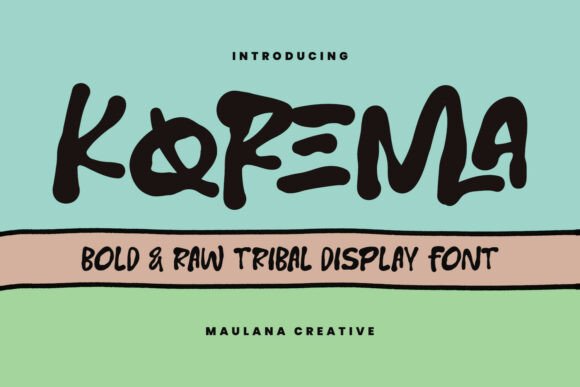
In the crowded landscape of contemporary typography, finding a display font that balances artistic expression with functional legibility is a persistent challenge for designers. Korema enters this space as a striking display typeface that deliberately rejects polished perfection in favor of raw, organic energy. It is defined by a modern urban tribal aesthetic, characterized by heavy, hand-drawn strokes and experimental ligatures that evoke an authentic street-style vibe. For professionals evaluating type assets for branding, editorial work, or environmental graphics, Korema represents a specific niche: it is a tool for projects requiring tactile presence and rugged individuality rather than corporate neutrality.
Defining the Visual Character and Aesthetic
Korema is not designed to be invisible. Unlike Swiss-style sans-serifs intended to recede into the background, this typeface demands attention through irregularity. The letterforms are bold and slightly inconsistent, mimicking the imperfections of hand-painted signage or marker art. This "human error" is engineered rather than accidental, providing a sense of authenticity that digital fonts often lack. The weight distribution varies across characters, creating a rhythmic texture when set in headlines. This organic variation prevents the visual fatigue sometimes associated with monolinear display fonts, making Korema particularly effective for medium-to-large scale applications where detail is visible.
The most distinctive technical feature is the inclusion of unique experimental ligatures. These are not merely decorative connectors but structural elements that alter the silhouette of word shapes. In practical application, these ligatures allow designers to create custom logotypes or poster titles without manually modifying vector paths. However, they also require careful typesetting; automatic ligature substitution can sometimes create awkward spacing or unintended connections in longer phrases. Understanding how these alternates interact is essential for maintaining readability while leveraging the font’s stylistic strengths.
Practical Applications and Real-World Performance
Evaluating Korema requires understanding its optimal use cases. Its heavy stroke weight and textured edges make it exceptionally strong in print environments. On uncoated paper stocks, the ink spread naturally complements the font's rough aesthetic, enhancing the artisanal feel. In digital contexts, performance depends heavily on resolution and size. At smaller web sizes (below 24px), the intricate details of the hand-drawn strokes may degrade or appear muddy on standard displays. Therefore, Korema performs best as a hero element—large headings, social media graphics, or packaging—rather than interface text or subheads.
For branding projects targeting youth culture or alternative markets, Korema provides immediate semiotic signaling. It communicates rebellion, creativity, and grassroots authenticity without relying on cliché grunge textures. We have observed effective use in independent music promotion, craft beverage labeling, and streetwear apparel. Conversely, applying this typeface to traditional corporate communications or luxury minimalism often results in tonal dissonance. The font carries significant cultural baggage; it reads as informal and energetic. Designers must ensure this aligns with the brand voice before committing to Korema as a primary display face.
Strengths in Editorial and Poster Design
In editorial layouts, Korema serves as a powerful anchor. When paired with a clean, high-x-height body text (such as a geometric sans-serif or a sturdy serif), it creates necessary contrast. The key to successful pairing is avoiding other typefaces with similar hand-drawn characteristics, which can make the layout feel chaotic. Instead, let Korema provide all the personality the design needs while supporting elements remain structured and neutral. In poster design, the font’s tight tracking capabilities allow for impactful, space-efficient headlines that maintain legibility even when cropped or overlaid on busy photography.
Technical Usability and Workflow Considerations
From a production standpoint, Korema generally demonstrates solid build quality. The glyph set typically includes sufficient language support for Western European languages, though users working with extended character sets should verify coverage before purchase. The OpenType features are accessible in major design software, including Adobe Illustrator, InDesign, and Affinity Designer. However, users of older software or basic web builders may find accessing alternate characters and ligatures cumbersome. It is advisable to test the font in your specific workflow environment to ensure the experimental features integrate smoothly with your existing tools.
Consistency is another factor worth examining. While the irregularity is intentional, professional typography requires predictable metrics. Korema maintains consistent baseline alignment and cap heights despite its organic forms, which simplifies grid-based layout work. Vertical metrics appear well-calibrated, reducing the need for manual leading adjustments in headline settings. This reliability distinguishes it from amateurish free fonts where aesthetic choices compromise technical functionality. For freelancers and agencies billing by the hour, this efficiency matters; Korema offers expressive results without excessive cleanup time.
Audience Fit and Strategic Value
Determining whether Korema fits your project involves honest assessment of audience expectations and long-term brand goals. The following profiles typically derive the most value from this typeface:
- Independent Brands: Businesses differentiating themselves from mass-market competitors through artisanal positioning or counter-cultural values.
- Event Marketers: Promoters of festivals, concerts, or pop-up experiences where visual impact and immediacy take precedence over extended reading comfort.
- Packaging Designers: Creators working on shelf presence for products like hot sauce, craft beer, or skate hardware where tactile aesthetics drive purchasing decisions.
- Editorial Art Directors: Professionals designing magazines, zines, or lookbooks that benefit from typographic variety and expressive headlines.
Conversely, Korema may introduce unnecessary friction for:
- Corporate Identity Systems: Unless the company specifically operates within creative industries, the font’s informality may undermine perceptions of stability and professionalism.
- Accessibility-Focused Interfaces: The irregular forms and heavy weight can reduce legibility for users with visual impairments, making it unsuitable for UI components or critical informational signage.
- Long-Form Content: Even at larger sizes, sustained reading in Korema becomes fatiguing due to its high contrast and textural density.
Limitations and Professional Recommendations
No typeface is universally applicable, and Korema has defined boundaries. Its strength is also its limitation: the pronounced personality leaves little room for reinterpretation. Once deployed, it dominates the visual hierarchy completely. This makes it less versatile than more restrained display faces that can adapt to multiple tones. Additionally, the trend cycle for urban tribal aesthetics moves relatively quickly. While Korema avoids dated grunge clichés, its current relevance ties it to contemporary street culture. Projects requiring timeless neutrality should consider this temporal association.
When implementing Korema, we recommend the following best practices to maximize effectiveness:
- Test Ligatures Manually: Do not rely solely on automatic substitution. Review each headline individually to ensure ligatures enhance rather than disrupt word recognition.
- Mind the Negative Space: The heavy strokes consume significant visual mass. Increase surrounding whitespace compared to what you might use with lighter typefaces to prevent the design from feeling suffocated.
- Verify Licensing Scope: Ensure your license covers intended uses, particularly for commercial branding, merchandise, or embedded web fonts. Display fonts often have tiered licensing based on impression counts or product units.
- Pair with Intention: Select body copy that contrasts in both form and function. A humanist sans-serif or transitional serif often provides better balance than another geometric or decorative face.
Assessing Long-Term Utility
For designers building a curated type library, Korema fills a specific gap between polished grotesques and distressed novelty fonts. It occupies the middle ground of refined rawness—a category increasingly relevant as audiences seek authenticity in digital-saturated environments. Its value lies not in versatility but in specialization. When a project calls for urban energy, handcrafted credibility, or bold statement-making, Korema delivers these qualities with professional-grade construction and thoughtful OpenType engineering.
Ultimately, the decision to adopt Korema should stem from project requirements rather than trend following. Evaluate it against your specific deliverables, audience demographics, and brand positioning. Test it in context before finalizing selections. When the fit is right, Korema transforms from mere letterforms into a strategic communication asset that resonates with viewers seeking genuine, unpolished expression in an increasingly sanitized visual world. Its contribution to modern typography is meaningful precisely because it refuses to smooth out the edges that make human-made things compelling.