Evaluating New Yark: A Practical Guide to Geometric Display Typography
Selecting the right display typeface is often the most critical decision in establishing a brand’s visual tone. For designers navigating the intersection of geometric precision and futuristic fluidity, New Yark presents a distinct option worth evaluating. Unlike traditional grotesque sans-serifs that prioritize neutrality, or ornamental scripts that sacrifice legibility for style, New Yark is engineered specifically for high-impact digital environments. It occupies a specific niche: projects requiring a "space-age" or metropolitan aesthetic that still retains professional versatility.
When comparing typography options for tech startups, automotive branding, or immersive gaming interfaces, it is essential to look beyond surface-level aesthetics. This analysis explores where New Yark fits within the broader landscape of modern display fonts, examining its technical specifications, practical applications, and the tradeoffs involved in choosing a typeface with such a strong personality.
Defining the Aesthetic: Geometry Meets Fluidity
New Yark distinguishes itself through a design philosophy that balances rigid structure with organic movement. Many geometric typefaces rely on perfect circles and straight lines, which can sometimes result in a sterile or cold appearance. Conversely, futuristic fonts often over-index on distortion, making them difficult to read at smaller sizes or in dynamic layouts.
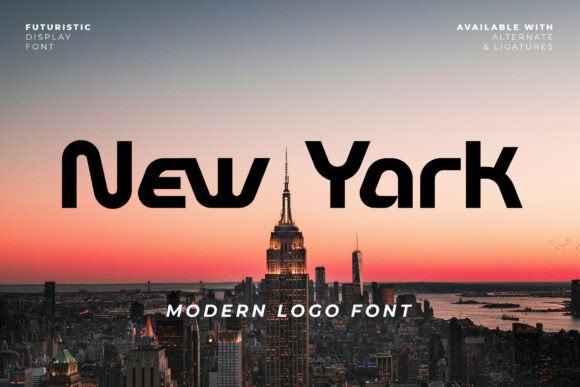
New Yark addresses this tension through wide-profile characters and smooth, rounded terminals. The width provides a sense of stability and "heaviness" necessary for headers, while the rounded edges introduce an approachable, hi-tech quality. This combination makes it particularly effective for brands that need to communicate innovation without appearing alienating. When evaluating this typeface against standard geometric options, consider whether your project benefits from this added layer of softness. If your brand requires strict, industrial rigidity, a more traditional neo-grotesque might be preferable. However, for consumer-facing tech or lifestyle brands, the fluidity of New Yark offers a more engaging user experience.
Technical Versatility and Customization
A significant factor in choosing a display font is the level of customization available without requiring external vector editing software. New Yark includes creative alternates and ligatures accessible via PUA (Private Use Area) encoding. This technical feature allows designers to customize wordmarks directly within layout software, effectively creating custom-drawn logos with minimal friction.
For teams working under tight deadlines or managing multiple brand touchpoints, this efficiency is a tangible benefit. Instead of outlining text and manually adjusting anchor points to create a unique lockup, designers can toggle alternates to achieve a bespoke look. When comparing resources, assess how much time your workflow allocates to logotype refinement. If rapid iteration is a priority, a typeface with robust OpenType features like New Yark offers a higher return on investment than a static font family that requires manual modification for every variation.
Comparative Analysis: When to Choose New Yark vs. Alternatives
No single typeface solves every design problem. Understanding where New Yark excels—and where it falls short—is crucial for informed decision-making. Below is a breakdown of how it compares to other common categories in the display typography space.
New Yark vs. Traditional Geometric Sans-Serifs
- Visual Weight: Traditional geometrics often have uniform stroke widths that can disappear on low-resolution screens or when used in light weights. New Yark’s bold weights are engineered for digital impact, maintaining presence even when paired with busy backgrounds or neon gradients.
- Personality: Standard geometrics are designed to be invisible vessels for content. New Yark is designed to be seen. It carries inherent connotations of cyberpunk and futurism. Choose traditional options for corporate reports or legal documents; choose New Yark for marketing campaigns, event branding, and product launches.
- Readability: For long-form body copy, traditional sans-serifs remain superior due to optimized x-heights and spacing. New Yark should be reserved for headlines, subheads, and short-form UI elements where its distinctive character enhances rather than hinders comprehension.
New Yark vs. Retro-Futuristic and Cyberpunk Fonts
The market is saturated with typefaces labeled "cyberpunk" or "sci-fi." Many of these rely heavily on distressing, glitch effects, or extreme stylization. While visually striking, they often lack the professionalism required for established businesses.
- Professional Finish: New Yark avoids grunge textures and broken letterforms. Its clean lines and smooth curves make it suitable for Silicon Valley startups and high-performance automotive brands that need to signal cutting-edge technology without sacrificing trustworthiness.
- Versatility: Highly stylized retro fonts often work only in specific color palettes or contexts. New Yark’s neutral-yet-distinctive foundation allows it to adapt to various color schemes, from monochrome minimalism to vibrant neon gradients.
- Longevity: Trend-heavy display fonts can date a design quickly. By focusing on geometric fundamentals rather than temporary visual gimmicks, New Yark offers a longer shelf life for brand identities.
Practical Applications and Best-Fit Scenarios
Evaluating a typeface requires testing it against real-world use cases. Based on its design characteristics and technical features, New Yark is particularly well-suited for the following scenarios:
Digital Product Interfaces and Gaming UI
In immersive digital environments, typography must contribute to world-building while remaining functional. New Yark’s wide stance and futuristic aesthetic align naturally with HUD (Heads-Up Display) designs, menu systems, and in-game signage. The rounded terminals prevent the type from feeling too aggressive during extended user sessions, while the bold weights ensure legibility against complex, animated backgrounds. For UI designers, the availability of alternates allows for consistent yet varied labeling without breaking the visual system.
High-Impact Marketing and Event Branding
When designing for large-format print or hero sections on websites, the typeface must hold its own against photography and video. New Yark’s heavy weights provide the necessary contrast to anchor compositions. Its compatibility with neon color gradients makes it a strong candidate for nightlife, music festivals, and tech conferences where lighting and atmosphere are central to the experience. Compared to thinner display fonts, New Yark reduces the risk of text getting lost in visually dense layouts.
Startup and Tech Company Identity
For companies in emerging sectors like AI, robotics, or electric mobility, the brand identity must communicate both innovation and reliability. New Yark bridges this gap by combining forward-looking aesthetics with solid typographic construction. The ability to create custom logotypes using built-in alternates is especially valuable for early-stage companies with limited branding budgets, allowing for a polished, proprietary look without commissioning a fully custom typeface.
Tradeoffs and Decision Factors
While New Yark offers significant advantages for specific applications, it is not a universal solution. Consider the following limitations before integrating it into your toolkit:
- Limited Weight Range: As a display-focused typeface, New Yark may not offer the extensive weight spectrum (from thin to black) found in comprehensive text families. If your project requires a single typeface for both headlines and body copy, you will likely need to pair New Yark with a complementary sans-serif.
- Strong Stylistic Voice: The font’s distinct personality means it will dominate any composition. It is less suitable for projects where typography should recede into the background or where multiple competing visual elements require neutral grounding.
- PUA Encoding Workflow: While PUA encoding ensures accessibility across software, it requires familiarity with glyph panels or character maps. Teams accustomed to standard OpenType feature menus may need a brief adjustment period to efficiently access all alternates and ligatures.
- Contextual Appropriateness: The futuristic aesthetic, while versatile within its niche, may feel out of place for heritage brands, luxury fashion houses favoring serif traditions, or organizations prioritizing warmth and tradition over technological association.
Making the Final Selection
Choosing New Yark ultimately depends on your project’s specific communication goals. If you are seeking a typeface that delivers immediate visual impact, supports efficient customization, and embodies a modern, tech-forward sensibility, it represents a strong contender. Its balance of geometric rigor and fluid approachability sets it apart from both sterile neutrals and overly stylized novelty fonts.
However, if your primary need is extended readability, subtle elegance, or historical resonance, exploring alternative categories will yield better results. Test New Yark in context: set actual headlines, experiment with the alternates, and evaluate its performance alongside your intended color palette and imagery. This hands-on evaluation, grounded in practical requirements rather than trend alone, will ensure your typographic choice serves both your aesthetic vision and your functional needs effectively.